Article · 8 Sept 2026 · 3 min read
Why the heart never gets tired: five facts about heart muscle
Your heart beats about 100,000 times a day and never takes a day off. Five facts about heart muscle explain how it keeps going.
At a typical resting heart rate, an adult heart beats about 100,000 times a day, day and night, for a whole lifetime. It never gets a rest day, yet a healthy heart does not tire the way your legs do at the end of a sprint. There is no single trick behind this. It comes down to how heart muscle is built and how it works.
1. It is packed with power stations
Heart muscle cells are crammed with mitochondria, the structures that use oxygen to turn fuel into ATP, the molecule cells use for energy. In heart muscle, mitochondria take up roughly a third of the volume of each cell, far more than in a typical skeletal muscle. That is the equipment for making energy continuously rather than in short bursts.
2. It runs on oxygen, and mostly on fat
The heart relies on aerobic metabolism: nearly all of its energy comes from burning fuel with oxygen. At rest, most of that fuel is fatty acids. The heart is also flexible and can use glucose, lactate and ketone bodies, depending on what the blood brings. During exercise, for example, it takes up some of the lactate released by working muscles and burns it.
What it cannot do for long is work without oxygen. Although its chambers are full of blood, the heart muscle is fed mainly by its own vessels, the coronary arteries.
3. It rests between every beat
Each heartbeat has two phases: systole, when the muscle contracts, and diastole, when it relaxes and the chambers refill. At a resting heart rate, diastole takes up roughly two-thirds of each cycle, so the muscle spends most of its time relaxing.
That pause also feeds the heart. The wall of the left ventricle receives most of its coronary blood flow during diastole, when the relaxed muscle is no longer squeezing its own vessels. As the heart rate rises, it is mainly diastole that gets shorter.
Heart muscle also has a long refractory period: after each contraction, it cannot be stimulated again until it has started to relax. So, unlike skeletal muscle, it cannot be locked into a sustained contraction. Relaxing between beats is built in.
4. It keeps its own time
The heartbeat starts in the heart itself, in a small cluster of specialised cells in the wall of the right atrium called the sinoatrial node. These cells fire rhythmically on their own: the brain does not have to tell the heart to beat. The nervous system adjusts the pace instead. At rest, the vagus nerve slows the heart down; during exercise or stress, sympathetic nerves and the hormone adrenaline speed it up. That is why a transplanted heart, whose nerve connections have been cut, still beats.
5. It keeps most of its cells for life
Adult heart muscle cells renew very slowly, on the order of 1% a year or less, and the rate falls with age. Most of the heart muscle cells you have as an adult are likely to stay with you for the rest of your life. Instead of replacing whole cells, the heart maintains them from within: their proteins and mitochondria are broken down and rebuilt all the time.
The flip side is that heart muscle lost to damage, for example in a heart attack, is usually replaced by scar tissue rather than new muscle.
See it in 3D
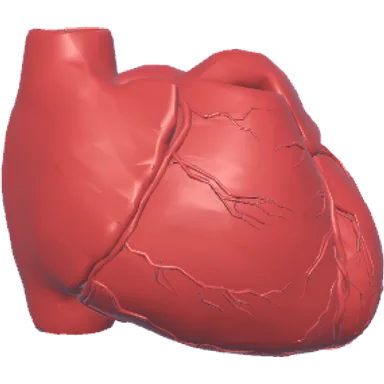
In the BODYVERSE model, the heart is made of 127 separate parts: the walls of its chambers, the valves, the papillary muscles, the coronary arteries and the cardiac veins. In the app, you will be able to isolate the heart and find each one.
This article is for general education only and is not medical advice. If you have questions about your heart, talk to a doctor.